
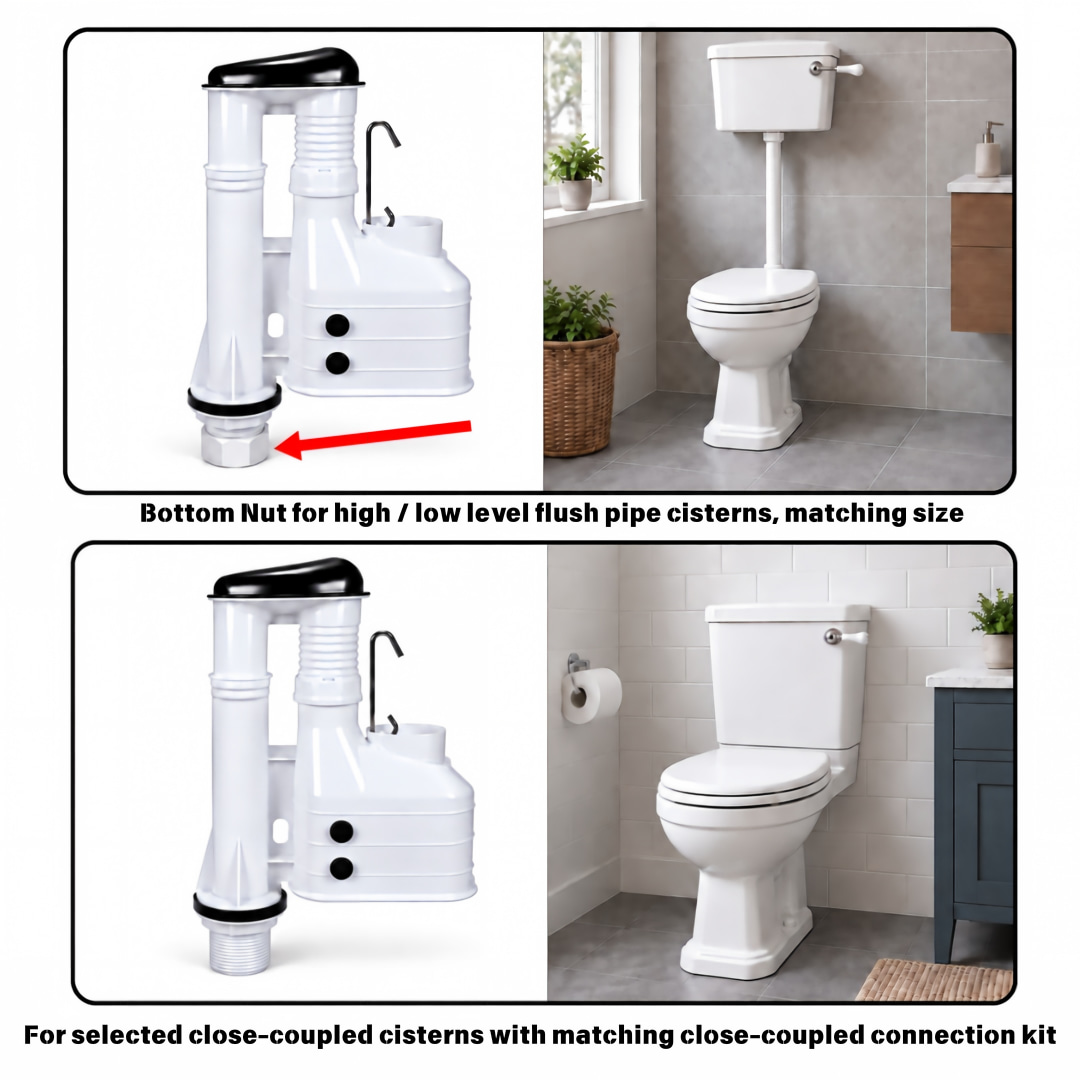
While working with toilet flush valves for the UK market, we noticed an interesting difference in the way some ceramic toilet cisterns are designed and installed.
Unlike many two-piece toilets commonly found in the US market, some UK ceramic cisterns do not have dedicated bolt holes in the bottom of the cistern.
Instead, the ceramic body may only provide openings for the inlet valve and the flush valve outlet.
This allows the same basic cistern design to support different installation configurations.
One common installation is a high-level or low-level cistern, where the cistern is separated from the toilet pan and connected by a flush pipe.
In this configuration, the flush valve is installed through the outlet hole in the bottom of the cistern.
A flush valve bottom nut, or backnut, secures the valve to the ceramic cistern. The flush pipe is then connected underneath the valve.
For this type of installation, no cistern-to-pan fixing bolts are required.
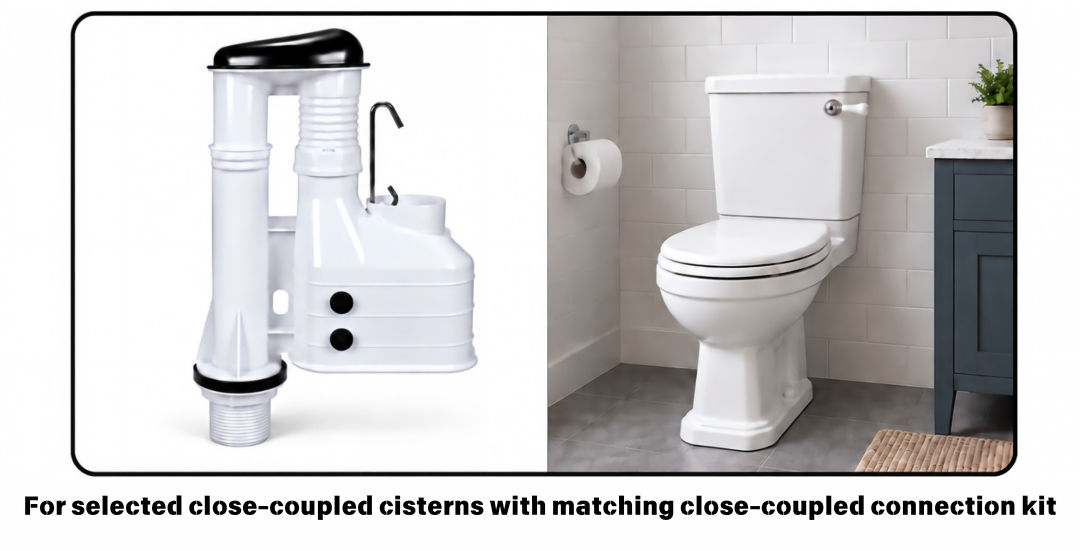
The situation becomes more interesting when a compatible cistern is installed directly on top of the toilet pan.
If the cistern itself does not contain separate fixing holes, another method is required to secure it to the pan.
This is where a close coupling kit is used.
A typical kit includes:
The metal plate is positioned around the flush valve outlet. The two bolts on the plate then extend downward through the corresponding holes in the toilet pan, allowing the cistern to be securely fastened.
UK manufacturers describe these kits specifically as a way of securing a close-coupled cistern to the pan while also providing a watertight connection.
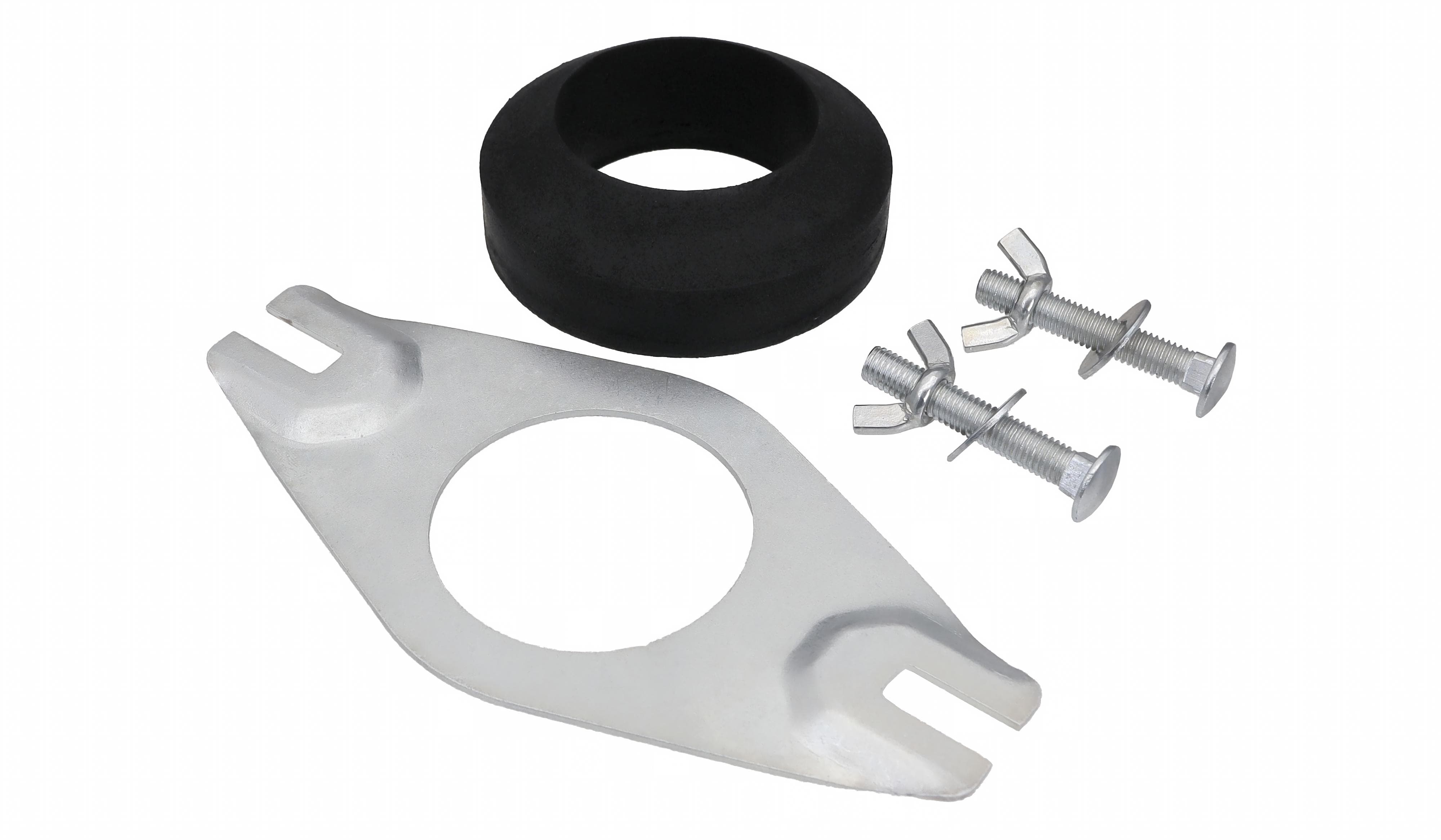
The flush valve outlet therefore performs two functions in this arrangement: it provides the flushing water passage and also acts as the central location around which the close-coupling plate is installed.
Once the close-coupling plate, bolts and sealing washer are installed, the assembly underneath the cistern looks like this:
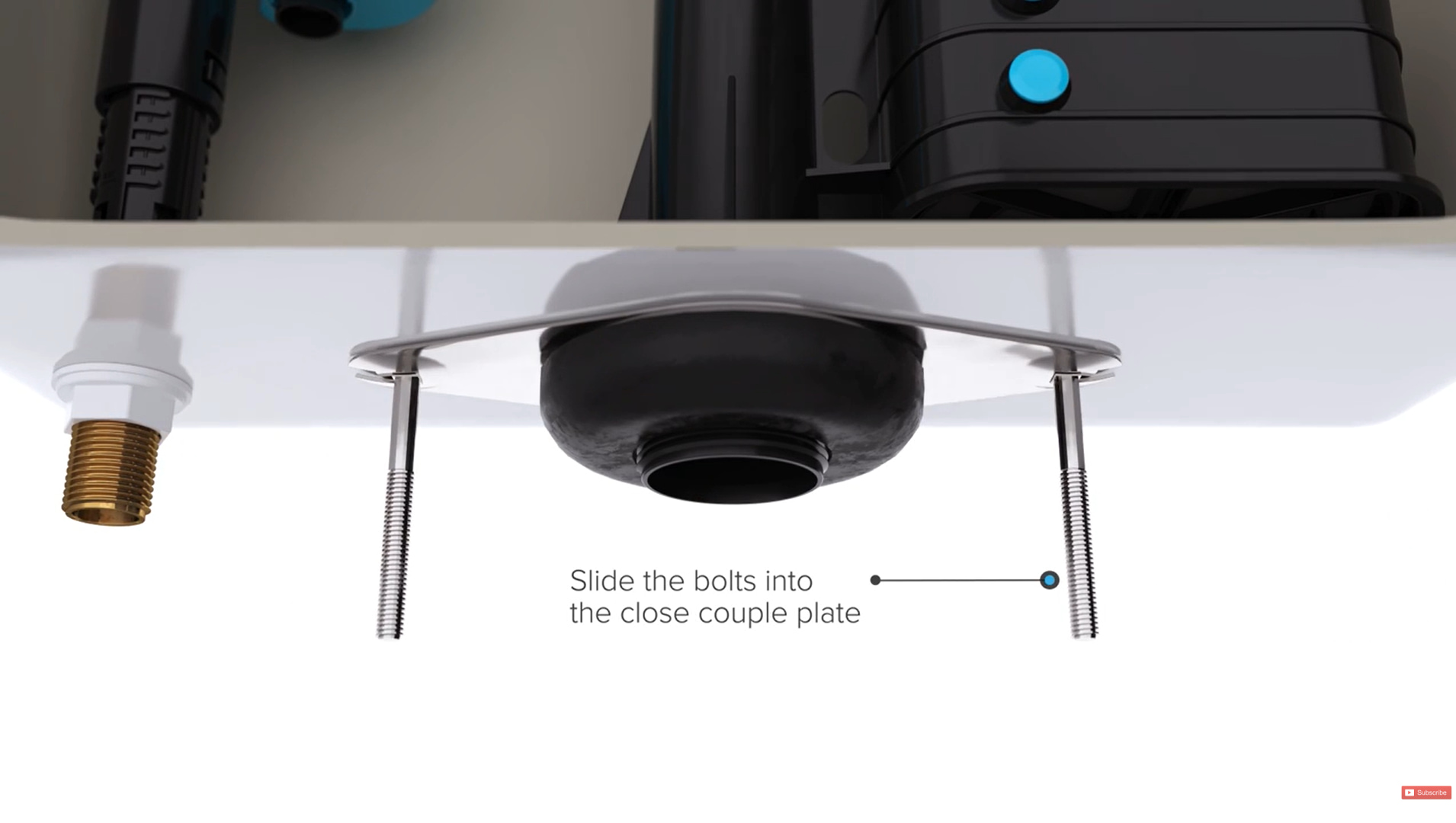
The bolts extend downward on both sides of the flush valve outlet and are used to secure the cistern to the toilet pan.
This creates a very different arrangement from many US-style two-piece toilets.
For example, installation instructions from Kohler show tank bolts passing directly through dedicated bolt holes in the bottom of the toilet tank before fastening the tank to the bowl.
For flush valve manufacturers and replacement-parts suppliers, understanding these installation differences is important.
A flush valve may appear very similar from one market to another, but details such as the outlet thread, bottom nut, cistern outlet size and close-coupling method can determine whether the valve is actually compatible with a particular toilet.
At Jielin Plumbing, we manufacture toilet inlet valves, flush valves and related toilet repair components for different markets. When developing or supplying replacement parts, we pay attention not only to the valve itself, but also to how the component interfaces with the ceramic cistern and toilet installation system.
For a more detailed view of how this type of flush valve and close-coupled connection is installed, you can also watch this installation video:
 3rd Floor, Building 3, No. 303 Shanmei Road, Jimei District, Xiamen, Fujian, China
 Telefone
: +8618906057133
Telefone
: +8618906057133 E-mail
: jack@jlplumbing.comE-mail
: qmmj@jlplumbing.com
E-mail
: jack@jlplumbing.comE-mail
: qmmj@jlplumbing.com WhatsApp : +8618906057133
 Rede IPv6 suportada
Nosso horário
24 horas online
 Português